Passing meaningful pharmacy benefit manager reform is rarely as simple as identifying a problem and writing a bill to fix it.
Pharmacists have to explain what PBM practices look like in the real world. Lawmakers have to understand why those practices matter. And supporters of reform have to build enough support to overcome the opposition that often follows significant PBM legislation.
Iowa’s experience with Senate File 383 shows what can happen when those pieces come together.
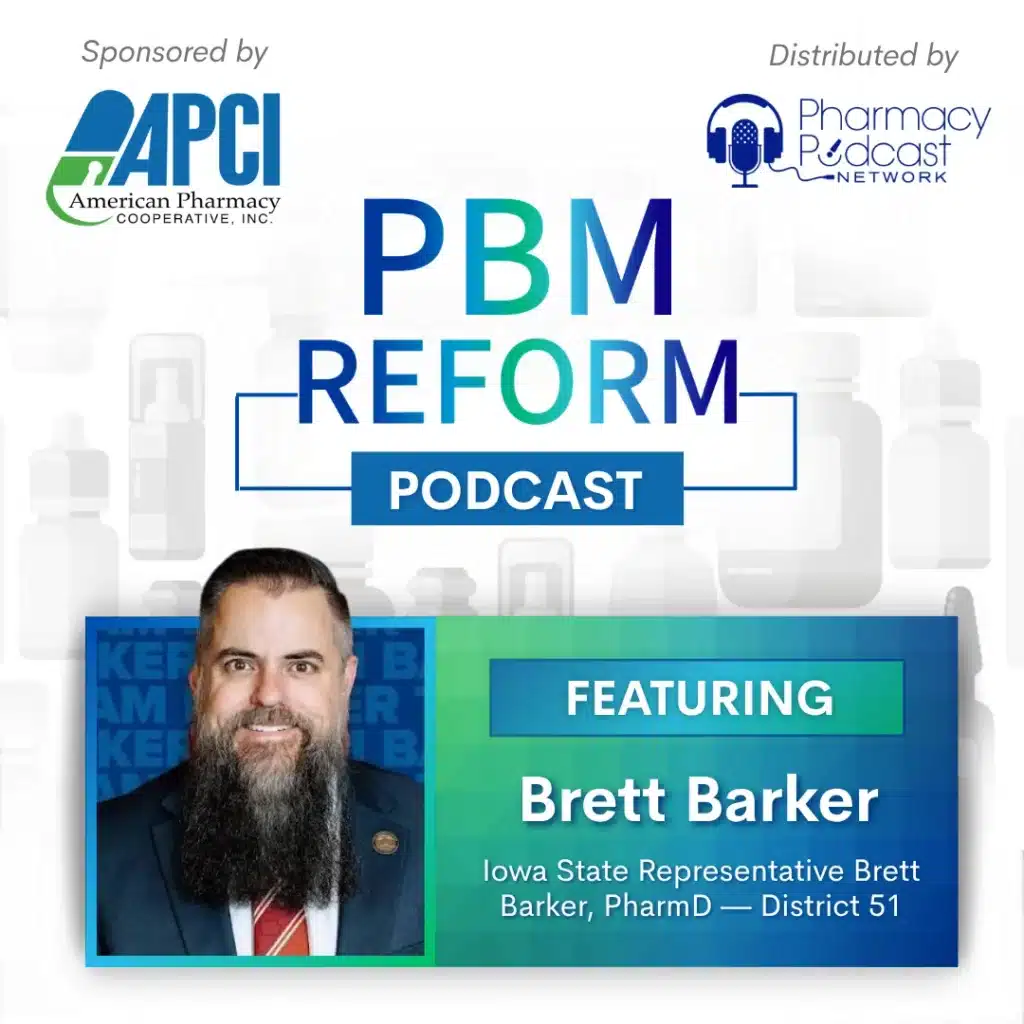
In the latest episode of the PBM Reform Podcast, guest host Todd Eury talks with Iowa State Representative Brett Barker, PharmD, about the passage of SF 383, the role pharmacists played in moving the legislation forward, and what pharmacy advocates in other states can learn from Iowa.
Barker brings a perspective few lawmakers can offer. He is both a state legislator and a practicing pharmacist, and he served as one of the House floor managers for SF 383.
What Iowa Changed
SF 383 established new requirements for PBMs and their relationships with pharmacies, health plans, and other payors.
The law addresses reimbursement and contracting practices, pass-through pricing, pharmacy appeals and disputes, network participation, and protections against discriminatory treatment of pharmacies. It also places greater emphasis on accountability for how prescription drug dollars move through the system, including requirements involving pass-through pricing among health plans, PBMs, and dispensing pharmacies.
The Iowa Senate passed the legislation 36–14, followed by a 75–15 vote in the House. Gov. Kim Reynolds signed SF 383 into law on June 11, 2025, and its primary provisions took effect July 1, 2025.
Pharmacists Helped Make the Case
Those final votes do not tell the whole story.
Barker and Eury discuss the work that happened before lawmakers ever cast their votes, including efforts by pharmacists, pharmacy owners, and pharmacy organizations to explain what was happening in community pharmacies.
That matters because PBM policy gets complicated fast. Reimbursement formulas, pharmacy contracts, network requirements, spread pricing, and appeals processes are everyday subjects inside pharmacy. They are not necessarily familiar to lawmakers who are being asked to make decisions about them.
Pharmacists can translate those issues into something much more concrete.
What happens when a pharmacy is reimbursed less than it costs to fill a prescription? What happens when contract or network decisions make it harder for a pharmacy to stay open? And what happens to patients when the pharmacy they depend on can no longer serve them?
Iowa’s experience shows why that connection matters. Pharmacy economics may be complicated, but their consequences are not.
A Pharmacist in the Legislature
Barker also was able to explain those issues from inside the legislature.
His background in community pharmacy gave him firsthand knowledge of pharmacy operations and prescription drug reimbursement as lawmakers considered SF 383.
In the podcast, Barker talks about using that experience to explain PBM economics to his colleagues, answer questions, and help lawmakers understand what the legislation would mean in practice.
His role points to a larger issue for the profession. Pharmacists do not have to run for office to influence public policy. But policymakers benefit from hearing directly from people who understand healthcare delivery firsthand. That can mean serving in elected office. It can also mean testifying before a committee, meeting with a legislator, providing examples from a pharmacy, or explaining how a proposed policy would affect patients and pharmacy operations.
Reform Still Requires Overcoming Opposition
SF 383 did not advance without opposition.
Barker discusses the resistance lawmakers encountered and the work required to build support for the bill. In the end, however, the legislation passed both chambers with support from lawmakers across the political spectrum.
The opposition also did not end when the bill became law. Shortly after Gov. Reynolds signed SF 383, the Iowa Association of Business and Industry, along with several employers and health plans, challenged the law in federal court. Among other claims, the plaintiffs argued that portions of the law are preempted by the federal Employee Retirement Income Security Act, or ERISA.
In July 2025, a federal judge issued a preliminary injunction preventing Iowa from enforcing certain provisions of SF 383 against the plaintiffs and their PBMs while the case proceeds. The injunction did not block the entire law or prevent the state from enforcing it against entities outside the case.
Iowa appealed, and the dispute reached the U.S. Court of Appeals for the Eighth Circuit this week. The court heard arguments September 22 over the challenged provisions and the lower court’s preliminary injunction. A decision is pending.
That adds another lesson to Iowa’s experience. Passing PBM reform may be one fight. Defending it after it becomes law may be another.
The PBM debate also has grown well beyond what a pharmacy is paid for a prescription. It now includes patient access, competition, prescription drug spending, transparency, state authority to regulate pharmacy benefits, and where the money moving through the prescription drug supply chain ultimately goes.
Those questions affect pharmacies. They also affect employers, health plans, taxpayers, and patients.
What Other States Can Learn From Iowa
Every state has its own laws, healthcare market, political environment, and pharmacy landscape. Iowa’s legislation is not a template that can simply be copied everywhere. But the process behind it offers lessons that travel well.
Pharmacists need to engage policymakers before legislation reaches a final vote. Complicated reimbursement issues have to be connected to what they mean for patients and communities. Lawmakers need reliable information from people who understand how pharmacy benefits work in practice. And meaningful reform usually requires building support beyond the pharmacy profession itself.
Iowa also shows that the work may not end with the governor’s signature. States that enact significant PBM reforms may have to defend those laws in court as well.
PBM reform is increasingly being debated state by state as lawmakers examine how pharmacy benefits affect prescription drug costs, patient access, and competition. The details will differ from one state to another.
The need for pharmacists to be part of that discussion will not.
Listen to the Podcast
Listen to Iowa State Representative Brett Barker, PharmD, and guest host Todd Eury discuss the passage of Senate File 383, the fight over the legislation, the role Iowa pharmacists played in advancing reform, and what pharmacists and policymakers in other states can learn from Iowa’s experience.
Listen to the latest episode of the PBM Reform Podcast.
Learn more about APCI’s work on PBM reform and other issues affecting independent pharmacy on our Public Policy page, or read the latest Public Policy news and analysis from APCI.