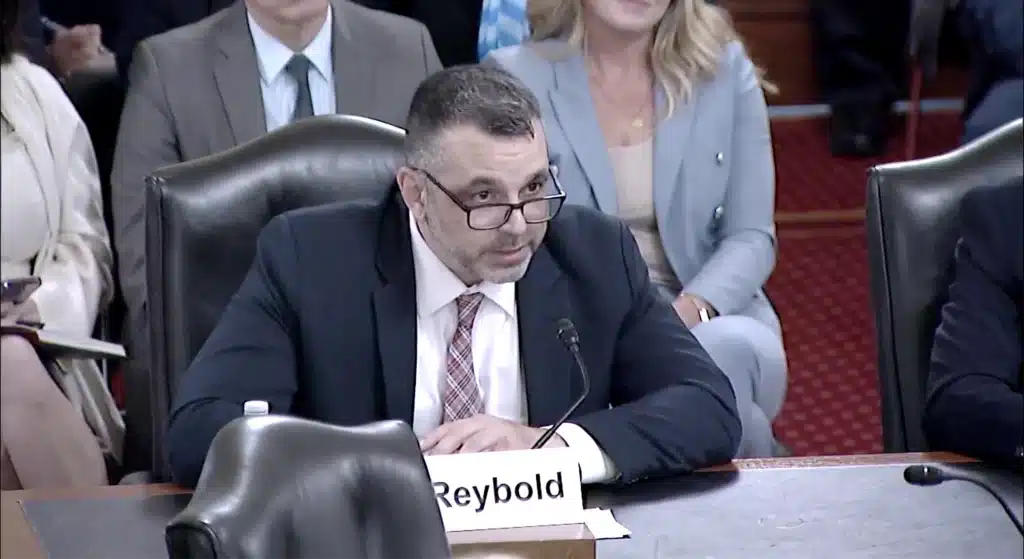
Greg Reybold, Vice President of Public Policy for American Pharmacy Cooperative, Inc. (APCI), called for an independent audit of Express Scripts’ administration of the TRICARE pharmacy program in remarks to the U.S. Senate Armed Services Subcommittee on Personnel on July 15, 2026.
In prepared written testimony submitted before the hearing, Reybold raised questions about the cost of the TRICARE mail-order pharmacy, the loss of community pharmacy access, and the Department of Defense’s ability to independently verify financial information reported by its pharmacy benefit manager.
The Department of Defense should not have to rely solely on its contractor’s assurances that every discount, fee, and financial benefit is being properly reported.
At the center of his recommendations was a call for the Department of Defense Office of Inspector General and the U.S. Office of Personnel Management Office of Inspector General to conduct a comprehensive audit of Express Scripts’ TRICARE operations.
Reybold also called for stronger standards in future TRICARE PBM contracts and changes to federal law that would protect beneficiary choice and establish more transparent pharmacy reimbursement.
Why Reybold called for an independent audit of the TRICARE pharmacy program
TRICARE provides healthcare benefits to approximately 9.5 million active-duty service members, military retirees, and their families. The Defense Health Agency has argued that its pharmacy program differs from a traditional commercial PBM arrangement.
Under the current contract, Express Scripts receives administrative fees, while the Department of Defense controls the formulary, retains negotiated savings, and prohibits spread pricing and certain other forms of PBM revenue.
Reybold acknowledged those differences. He argued, however, that contract terms and contractor-reported information are not substitutes for independent oversight.
“Structural differences do not negate the need for rigorous oversight or accountability,” Reybold wrote. “Rather, they require closer scrutiny and increased vigilance.”
That concern is consistent with a 2025 Government Accountability Office report recommending that the Defense Health Agency improve its monitoring of contractor-reported data.
His testimony cited federal audits of Express Scripts’ work for health plans participating in the Federal Employees Health Benefits Program. One was the Compass Rose Health Plan pharmacy operations audit. Those audits found that millions of dollars in pharmacy discounts, transaction fees, manufacturer rebates, purchasing discounts, and other financial benefits were not passed through as required.
Two of the audits cited by Reybold identified more than $18 million in retail pharmacy discounts and more than $3 million in pharmacy transaction fees that were not passed through to the health plans.
Those findings do not prove that the same practices occurred within TRICARE. They do, however, raise a question that the Department of Defense should be able to answer independently.
Express Scripts has stated in court filings that it performs pharmacy network services for TRICARE and non-TRICARE clients on an indivisible basis. Additionally, the company has said that it does not negotiate separate agreements with retail pharmacies specifically for TRICARE.
If the same pharmacy agreements and aggregate pricing practices are used across multiple lines of business, Reybold asked, how can the Department of Defense verify that every discount, fee, and other financial benefit associated with TRICARE is being accurately reported and returned to the program?
Is TRICARE mail order always less expensive?
Reybold’s prepared statement challenged the assumption that the TRICARE mail-order pharmacy is consistently less expensive than community pharmacies.
Federal law gives mail order several built-in advantages. Certain maintenance medications generally must be filled through a military treatment facility or the national mail-order pharmacy. The copayment structure also makes retail pharmacy appear more expensive to the beneficiary.
Under the 2026 cost-sharing structure cited in Reybold’s testimony, a beneficiary pays $14 for a 90-day supply of a generic medication through mail order. Filling the same medication as three 30-day prescriptions at a retail pharmacy can result in a maximum total copayment of $48.
That comparison looks very different when the government’s cost is considered.
Department of Defense data included in Reybold’s prepared remarks showed that the average government cost of a 30-day generic prescription was higher through mail order than through retail pharmacy in several years:
| Fiscal year | Average retail cost | Average mail-order cost | Difference |
|---|---|---|---|
| 2017 | $15 | $21 | Mail order 40% higher |
| 2018 | $14 | $26 | Mail order 85% higher |
| 2019 | $12 | $15 | Mail order 25% higher |
| 2020 | $9 | $12 | Mail order 33% higher |
| 2022 | $8 | $9 | Mail order 12.5% higher |
The Department of Defense has also acknowledged that the average beneficiary copayment for a retail generic prescription can be lower than the copayment for home delivery.
The data do not show that every prescription costs less at a retail pharmacy. They do show that mail order should not automatically be treated as the least expensive option for military families or taxpayers.
TRICARE network cuts reduced pharmacy access
Another issue Reybold addressed was the decrease in the TRICARE retail pharmacy network.
After the Defense Health Agency relaxed its pharmacy access requirements in 2022, nearly 15,000 community pharmacies were removed from the network. Approximately 380,000 TRICARE beneficiaries were required to find another pharmacy.
Independent pharmacies were disproportionately affected.
In Arkansas alone, 401 retail pharmacy locations were outside the TRICARE network as of July 2026. Of those, 249 were independent pharmacies.
The network reduction occurred even as retail pharmacy use was increasing and mail-order use had declined from 65 percent in fiscal year 2018 to 56 percent in fiscal year 2022.
That deserves closer scrutiny, particularly when the Department of Defense’s own data showed that retail pharmacies were frequently the less expensive option for generic medications.
Reybold’s recommendations for TRICARE pharmacy reform
Reybold’s prepared remarks included three primary recommendations.
Conduct an independent interagency audit
Reybold recommended a joint audit by the Department of Defense Office of Inspector General and the OPM Inspector General.
The audit would examine Express Scripts’ retail pharmacy contracts, reimbursement schedules, aggregate pricing, post-adjudication offsets, transaction fees, manufacturer and wholesaler discounts, mail-order inventory practices, and the accuracy of information reported to the Department of Defense.
It should also determine whether Express Scripts or an affiliated company receives any financial benefit associated with TRICARE prescription volume that is not being fully reported and passed through to the federal government.
Strengthen future TRICARE PBM contracts
Reybold recommended that future TRICARE contracts prohibit the contracted PBM from owning or controlling mail-order and specialty pharmacies participating in the program.
He also called for prohibitions on aggregate pricing, effective-rate pricing, post-adjudication offsets, and other non-claim-specific discounts or fees that could allow a PBM to generate revenue outside the terms of its government contract.
Future contracts should include stronger retail pharmacy access standards, transparent reimbursement, any-willing-provider protections, and recurring independent audits.
Protect beneficiary choice
Reybold urged Congress to remove federal policies that favor mail order and penalize beneficiaries who choose to use community pharmacies.
His recommendations included eliminating statutory mail-order mandates, removing artificial copayment differences, establishing federal any-willing-provider protections, prohibiting PBM patient steering and post-adjudication clawbacks, and adopting transparent, market-based pharmacy reimbursement.
He also recommended using a transparent market index similar to the National Average Drug Acquisition Cost models included in proposed federal pharmacy legislation.
The Department of Defense should not have to rely on assurances
The concerns raised in Reybold’s testimony are not limited to what pharmacies are paid.
They affect whether military families have meaningful access to trusted community pharmacies. They affect whether taxpayer dollars are being used efficiently. They also raise questions about whether a vertically integrated PBM can benefit from decisions that move prescriptions away from community pharmacies and into its own mail-order operation.
The testimony reflects APCI’s broader public policy work to improve pharmacy reimbursement, patient choice, and accountability in the prescription drug market.
The Department of Defense should not have to rely solely on its contractor’s assurances that every discount, fee, and financial benefit is being properly reported.
An independent audit would give Congress, military families, pharmacies, and taxpayers a much clearer answer.