This is the first installment of “PBM Talking Points UNPACKED”, an APCI series examining familiar claims about pharmacy benefit managers, what those claims get right, what they leave out, and why the missing context matters to patients, pharmacies, employers, and policymakers.
Pharmacy benefit managers (PBMs) play a major role in how prescription drugs are covered and paid for in the United States. One of their primary functions is negotiating rebates and discounts with drug manufacturers on behalf of health plans.
But a basic question remains: If PBMs negotiate billions of dollars in rebates and discounts, where do those savings go, and how much of those savings reach patients at the pharmacy counter?
While it is true that PBMs negotiate rebates that can lower a health plan’s overall net drug costs, that isn’t the whole story. What’s left out is who actually benefits from these lower costs. Journalists, patients, legislators, and regulators have all asked where those savings ultimately go, but there is no single answer; it can vary depending on the contract, benefit design, and payment structure.
A drug’s negotiated rebate, the price paid by a health plan, and a patient’s out-of-pocket cost are not the same thing.
What Are PBMs and What Do They Do?
PBMs administer prescription drug benefits for health plans and employers. Their responsibilities can include negotiating with drug manufacturers, developing formularies, contracting with pharmacy networks, and processing prescription claims.
The three largest PBMs (CVS Caremark, Optum Rx, and Express Scripts) processed nearly 80 percent of prescriptions dispensed by U.S. pharmacies in 2023, according to the FTC’s Interim Staff Report. All three are part of parent companies that also own insurers, pharmacies, and other healthcare businesses.
How Do PBM Rebates Work?
A PBM rebate is a payment or price concession a PBM negotiates with a drug manufacturer on behalf of a health plan or employer. These rebates can reduce the net cost of covered prescription drugs. Manufacturers may offer rebates and other price concessions that are tied to more favorable formulary placement or preferred coverage.
A formulary is the list of prescription drugs a health plan covers and the terms under which those drugs are covered. When multiple drugs treat the same condition, those financial arrangements can influence which products receive preferred placement on the formulary.
That incentive can sometimes work in unexpected ways. Research cited in APCI’s America’s Drug Rebate Addiction found an association between larger rebates and higher list prices and documented cases in which higher-priced, highly rebated drugs received favorable formulary treatment over lower-cost alternatives.
That matters because lowering a health plan’s net cost after rebates is not necessarily the same thing as lowering the drug’s list price or what the patient pays.
Why Don’t PBM Rebates Always Lower What Patients Pay?
When patients come to the counter to pick up their prescriptions, their out-of-pocket cost may not reflect the rebates negotiated by the PBM. Depending on the benefit design, patients may pay a flat copay, meet a deductible, or pay coinsurance based on a price that does not reflect the drug’s eventual net cost after rebates.
In those cases, the patient may not directly benefit from the negotiated savings.
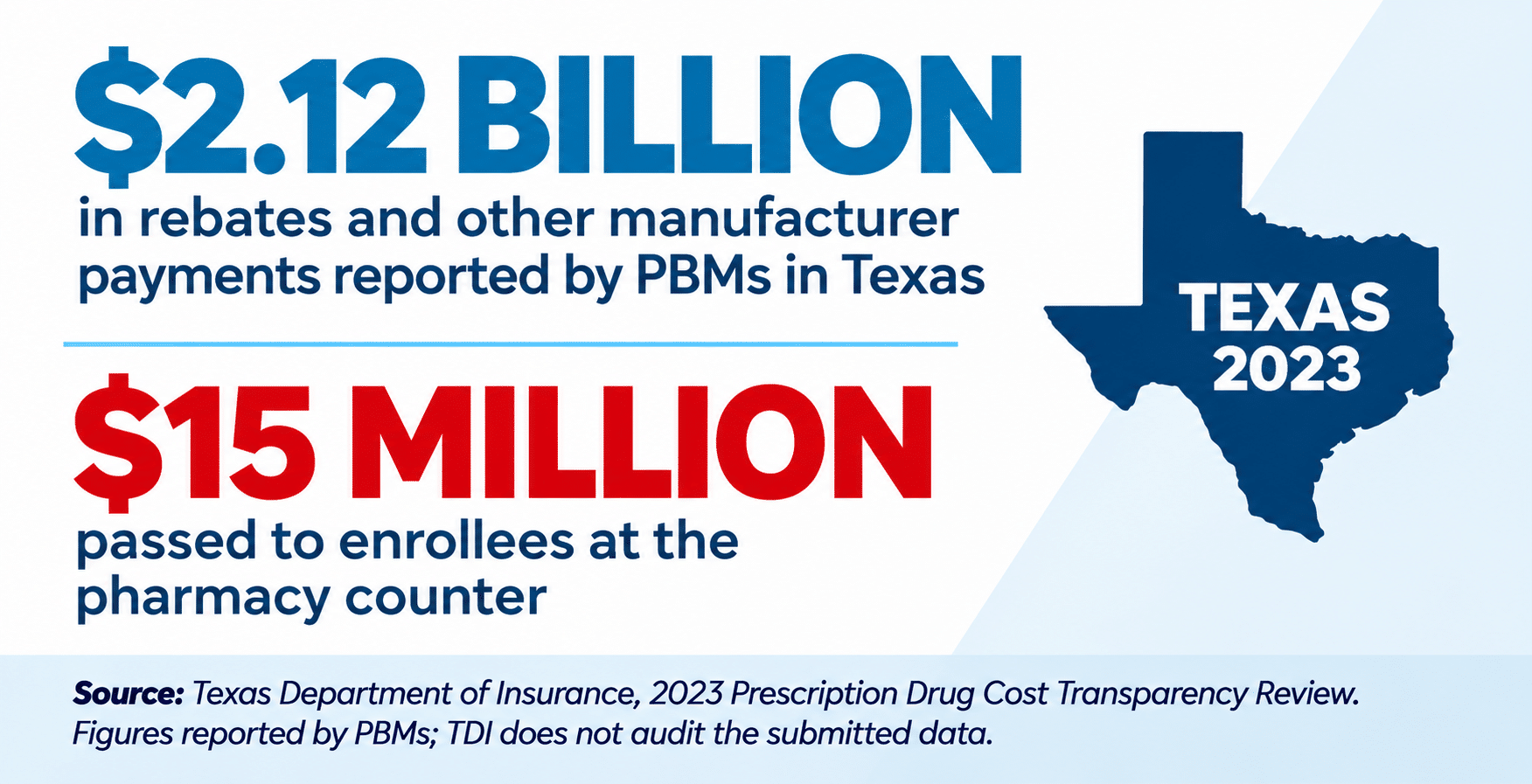
The numbers can be striking. In 2023, PBMs collected $2.12 billion in rebates and other manufacturer payments in Texas, according to the Texas Department of Insurance. Only $15 million of that amount was passed to enrollees at the pharmacy counter.
Another prominent example involves insulin. In 2024, the Federal Trade Commission sued the three largest PBMs and their affiliated group purchasing organizations, alleging that their rebate practices favored higher-list-price insulin products over lower-cost alternatives. The FTC alleged those arrangements could increase costs for patients whose cost-sharing obligations were tied to the drug’s list price.
Express Scripts reached a settlement with the FTC in February 2026, and Caremark reached a settlement in July. The FTC’s case involving Optum was withdrawn from adjudication while the Commission considers a proposed consent agreement.
The point is not that every prescription benefit works the same way. It is that a rebate can lower what a plan ultimately pays without lowering what the patient pays when the prescription is filled.
What Are PBM Rebate Aggregators and GPOs?
The largest PBMs also have created affiliated group purchasing organizations (GPOs). These entities, sometimes referred to as rebate aggregators, negotiate rebates and other payments with drug manufacturers.
An FTC report notes that PBMs began using GPOs in the last decade. The report says industry experts and members of Congress have raised concerns that affiliated rebate aggregators may allow PBMs to retain revenue through additional fee structures. It also cites concerns that these arrangements can limit oversight, including audits, by PBMs’ health-plan clients.
The report further cites a former PBM executive who said an affiliated GPO was created “to create a fee structure that can be retained and not passed on to a client.”
Federal audits provide a real-world example of why those distinctions matter.
An APCI Insights review of several federal audits found more than $517 million in drug manufacturer payments and other discounts that auditors determined had been withheld from Federal Employees Health Benefits Program plans by the Big 3 PBMs, their affiliated GPOs, and affiliated pharmacies. Some of those payments were later credited following audit review.
The finding illustrates why simply asking whether a PBM “passes through rebates” may not tell the whole story. Manufacturer payments can take different forms and may flow through affiliated businesses before the final cost of the prescription benefit is known.
So Where Do the Savings Go?
There is no single answer because rebate arrangements vary by contract and plan. Depending on the arrangement, negotiated savings may be passed through to a health plan or employer or used to reduce overall benefit costs. At the same time, PBMs and affiliated entities may receive separate fees and other forms of compensation associated with the prescription drug benefit.
What is much clearer is that negotiated rebates overwhelmingly do not appear as direct savings for patients at the pharmacy counter.
The growing complexity of PBM contracts, rebate arrangements, and affiliated rebate aggregators makes transparency increasingly important. Patients deserve to understand how their prescription costs are determined, and employers and other health plan sponsors need enough visibility into their PBM arrangements to understand how rebates, fees, discounts, and other payments move through the system.
APCI supports reforms that make those financial relationships transparent and ensure that manufacturer rebates and other negotiated savings cannot simply disappear behind narrow definitions, affiliated companies, or fee structures. For patients, that includes making sure negotiated savings can reduce what they pay when they need their medication. APCI’s detailed rebate policy analysis is available in the America’s Drug Rebate Addiction Insights white paper.
So yes, it is true that PBMs negotiate rebates with drug manufacturers.
The more important question is how those rebates, fees, and other forms of compensation move through the system and, most importantly, who ultimately benefits from them.
That is the context the simple claim that “PBMs negotiate lower drug costs” leaves out.