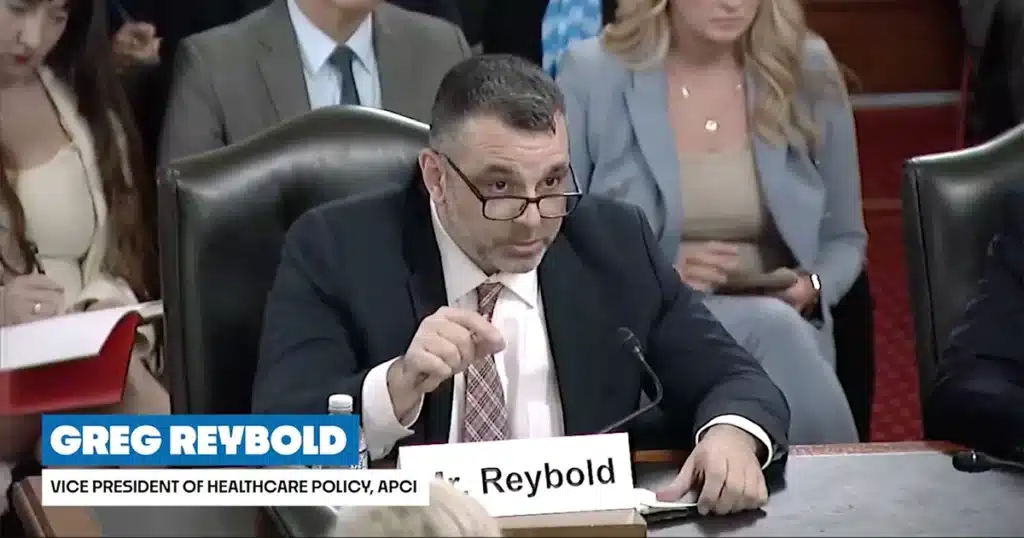
Greg Reybold, Vice President of Public Policy for American Pharmacy Cooperative, Inc. (APCI), called for greater transparency and independent oversight of the TRICARE pharmacy program during a July 15, 2026, hearing before the U.S. Senate Armed Services Subcommittee on Personnel.
A new video from APCI brings together key moments from the hearing, including exchanges involving Reybold, Senators Elizabeth Warren and Angus King, independent pharmacy owner Micah Lansford, and Express Scripts President Adam Kautzner.
The hearing examined whether the TRICARE pharmacy program is delivering the access, savings, and accountability that military families and taxpayers have been promised.
At the center of the discussion was Express Scripts, the pharmacy benefit manager responsible for administering the program.
Questions about TRICARE oversight
The Department of Defense has argued that the TRICARE pharmacy program differs from a traditional commercial PBM arrangement.
Under the current contract, Express Scripts receives administrative fees, while the Department of Defense controls the formulary, retains negotiated savings, and prohibits spread pricing and certain other forms of PBM revenue.
Those contract terms are important. They are not, however, a substitute for independent verification.
During the hearing, Reybold emphasized the need for the Department of Defense to look beyond the assurances and financial information provided by its contractor. He called for a comprehensive audit of Express Scripts’ TRICARE operations by the Department of Defense Office of Inspector General and the U.S. Office of Personnel Management Office of Inspector General.
The goal is straightforward: determine whether every discount, fee, and other financial benefit associated with TRICARE is being accurately reported and returned to the program.
The effect on military families and community pharmacies
The hearing also addressed the sharp reduction in the TRICARE retail pharmacy network.
Nearly 15,000 community pharmacies were removed from the network after the Defense Health Agency relaxed its pharmacy access requirements in 2022. Approximately 380,000 TRICARE beneficiaries were required to find another pharmacy.
Independent pharmacies were disproportionately affected.
Lansford provided the perspective of a pharmacy owner serving patients directly, while senators questioned how network decisions and reimbursement practices affect access to care for military families.
Those concerns are especially important in rural and underserved communities, where losing a local pharmacy may mean losing one of the most accessible healthcare providers in the area.
Is mail order always the least expensive option?
Another issue raised during the hearing was the assumption that the TRICARE mail-order pharmacy is consistently less expensive than community pharmacies.
Federal law gives mail order several built-in advantages, including copayment structures that can make retail pharmacy appear more expensive to beneficiaries.
Department of Defense data, however, show that the average government cost of a generic prescription has been higher through mail order than through retail pharmacy in several years.
That does not mean every prescription is less expensive at a community pharmacy. It does mean the government should not automatically assume that directing prescriptions to mail order produces the best result for military families or taxpayers.
The fact that Express Scripts administers the benefit while also operating the program’s mail-order pharmacy makes independent oversight even more important.
A need for answers, not assurances
The hearing made clear that the questions surrounding the TRICARE pharmacy program are not limited to what pharmacies are paid.
They involve beneficiary choice, access to trusted community pharmacies, the use of taxpayer dollars, and the ability of the Department of Defense to independently verify the performance of one of its largest contractors.
Reybold’s recommendations included an independent audit, stronger standards for future TRICARE PBM contracts, and changes to federal law that would protect beneficiary choice and establish more transparent pharmacy reimbursement.
An independent audit would provide Congress, military families, pharmacies, and taxpayers with a much clearer answer.
Read more about Reybold’s call for an independent audit of the TRICARE pharmacy program and review his prepared written testimony submitted before the hearing.